
It’s one of the most common moments in our chair. The X-rays come up, we point out a spot that needs attention, and the patient says, “But it doesn’t hurt.” That reaction makes complete sense. Most of us learned to think of a cavity as a toothache, so a cavity you can’t feel sounds like a contradiction.
Here’s what’s actually going on inside the tooth, how we decide whether a spot should be watched or filled, and the questions worth asking so you feel confident about any treatment you agree to.
Key takeaways
- Most cavities don’t hurt until they’re deep, because the outer layer of the tooth has no nerves.
- Pain usually means decay has reached, or is close to, the nerve. By then, the fix is often bigger.
- Not every spot needs a filling. Early enamel changes can sometimes be watched and strengthened with fluoride.
- Once decay breaks through the surface or reaches the inner layer, it won’t repair itself.
- You should always be able to see what your dentist sees and understand why a filling is or isn’t recommended.
Three layers, three very different feelings
Whether a cavity hurts depends almost entirely on how deep it has gone. A tooth is built in layers, and each one reacts differently to decay.
Outer layer
Enamel
The hardest material in your body, and it has no nerves. Decay here is completely silent.
Usually no feelingMiddle layer
Dentin
Softer than enamel, with tiny channels that lead toward the nerve. Decay spreads faster here. You might notice a quick twinge with cold or sweets, or nothing at all.
Maybe mild sensitivityCenter
Pulp
Nerves and blood vessels. When decay gets this close, lingering pain, throbbing, or swelling usually begins.
Pain often starts here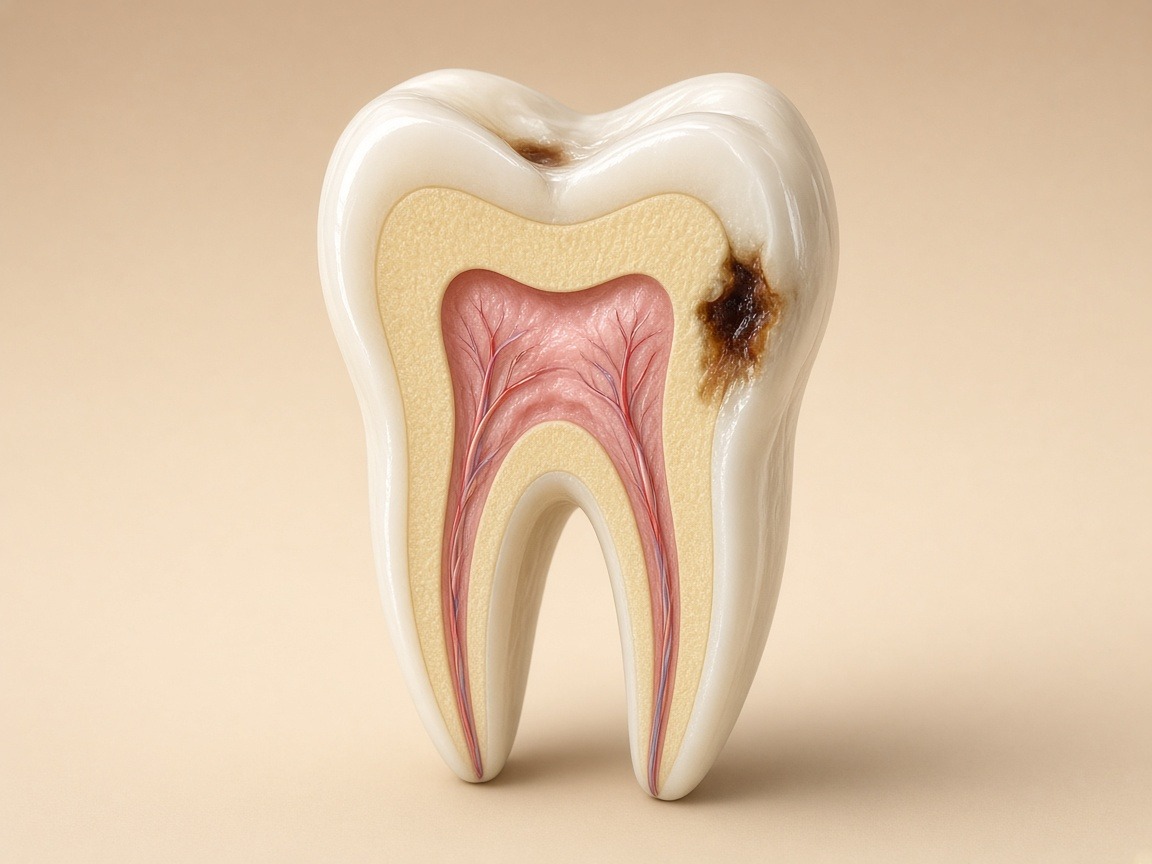
So if you feel fine, that usually means one of two things: the decay is still shallow, or it’s deeper but hasn’t irritated the nerve yet. Either way, the absence of pain tells you very little about how big the problem is.
What we can see that you can’t
Many cavities start in places you’d never spot in a mirror: between two back teeth where they touch, deep in the grooves of a molar, or along the edge of an older filling or crown. Finding them takes a few tools working together.
- A careful exam. We look and gently feel for changes in color and texture. Healthy enamel is smooth and hard; early decay can look chalky or feel slightly soft.
- Digital X-rays. These show decay hiding between teeth and under the surface, long before it’s visible. They also let us compare against past images to see whether a spot is growing.
- Checking older dental work. Fillings and crowns don’t decay, but the tooth around their edges can.
- Your personal risk. Frequent snacking or sipping, dry mouth from certain medications, and a history of cavities all make new decay more likely and change how closely we watch early spots.

This is a big part of why regular checkups matter. Catching decay while it’s small and painless is what keeps treatment small too.
Watch it or fill it? How the decision gets made
Finding a spot doesn’t automatically mean drilling. The decision depends on how deep it goes, whether the surface has broken down, and how quickly it seems to be changing.
| What we find | What it usually means | Typical next step |
|---|---|---|
| A chalky white or light brown spot, surface still smooth and hard | Early mineral loss in the enamel, with no hole yet | Often watched: fluoride, a few habit changes, and a recheck at your next visit |
| A spot that’s soft, sticky, or has broken through the surface | The enamel has given way and decay is active | A filling while it’s still small |
| Decay that reaches into the dentin on the X-ray | The cavity is moving toward the nerve | A filling soon; a larger area may need a crown |
| Decay that reaches the pulp, or pain and swelling | The nerve is inflamed or infected | Root canal treatment, usually followed by a crown |
The first row is the one worth knowing about. An early spot that hasn’t broken the surface can sometimes harden again with fluoride and better habits. Once there’s an actual hole, or the decay is into the dentin, the tooth can’t rebuild that structure on its own, and waiting only gives it room to grow.
Why waiting for pain usually costs more
Decay rarely stops by itself once it’s active. As it grows, the repair grows with it:
- 1Small filling. Quick, conservative, keeps most of the natural tooth.
- 2Larger filling. More tooth removed, and the tooth is weaker afterward.
- 3Crown. Needed when too little healthy tooth is left to hold a filling.
- 4Root canal and crown. Once infection reaches the pulp.
- 5Extraction and replacement. If the tooth can’t be saved, it may need a dental implant or bridge.
Every step up takes more time, more of your natural tooth, and usually more money. Treating a cavity while it’s painless is how you stay at step one.
Questions worth asking about your diagnosis
Being told you have cavities when you feel fine can make anyone a little skeptical. That’s healthy. These questions will help you understand exactly what’s going on:
- ✓Can you show me where it is on the X-ray?
- ✓Is it still in the enamel, or has it reached the dentin?
- ✓Is this a spot we can watch, or does it need a filling now?
- ✓What’s likely to happen if I wait until my next visit?
- ✓What can I do at home to keep this from getting worse?
A good dentist welcomes these questions. And if another office found cavities and you’d like a second look before treatment, we’re happy to review your X-rays with you and talk it through.
How to keep early spots from becoming cavities

- Brush twice a day with fluoride toothpaste, and spit instead of rinsing so the fluoride stays on your teeth longer.
- Clean between your teeth every day. That’s where many cavities begin.
- Watch how often, not just how much. Sipping a sweetened coffee, soda, or sports drink over a few hours keeps your teeth under attack the whole time.
- Reach for water between meals, and choose snacks like cheese, nuts, or crunchy vegetables.
- Ask about a fluoride treatment at your visit if you have early spots or a history of cavities.
- Mention dry mouth. Many common medications reduce saliva, which is one of your teeth’s best natural defenses.
Our preventive dentistry visits are built around exactly this: finding small problems early and keeping them small.
Have dental benefits left this year?
Fillings are usually covered as basic care, and treating a small cavity now costs far less than a bigger repair later. Here’s how to use your dental benefits before they reset.
Frequently asked questions
Can a cavity go away on its own?
An early spot of mineral loss, before there’s a hole, can sometimes harden again with fluoride and good habits. Once the surface has broken down or decay has reached the dentin, it can’t repair itself and needs treatment.
How long can I wait to fill a cavity that doesn’t hurt?
There’s no safe universal timeline. Some small cavities grow slowly and others move quickly, especially in the softer dentin. Ask your dentist how deep it is and what’s likely to change before your next visit.
Why did a new dentist find cavities my last dentist didn’t?
There are a few honest reasons. Decay may have developed since your last X-rays, newer images may show areas more clearly, and dentists differ on when to treat versus watch an early spot. Ask to see the X-rays and whether each spot is a “watch” or a “fill.”
Is a dark spot on my tooth always a cavity?
No. Coffee, tea, and red wine can leave stains in the grooves of your back teeth that look like decay. An exam and X-rays tell the difference between a stain and a cavity.
Does getting a filling hurt?
The area is numbed first, so most people feel pressure rather than pain. Some mild sensitivity for a few days afterward is normal. Small fillings are usually quick.
How often do I need dental X-rays?
It depends on your risk. Adults with healthy teeth and few cavities need them less often than people who get cavities frequently. Your dentist will recommend a schedule based on your history.
Not sure what’s going on with a tooth?
Book a checkup with Dr. Azadeh Ashtiany. We’ll show you what we see, explain whether a spot should be watched or treated, and walk you through every option before anything is done.
This article is for general education and isn’t a substitute for an individual dental exam. If you have pain, swelling, or a broken tooth, see our emergency dental care page or call the office.